

Before we go into more detail about how to choose the right niche and the mistakes to avoid, let’s first understand what a niche actually is. A niche is simply a specific area or topic you choose to focus on—but more importantly, it’s the group of people you decide to help. It’s not just about what you talk about, it’s about who you’re talking to and the problem you’re helping them solve. For example, instead of trying to speak to everyone, you narrow it down to a specific group with a specific need. That’s what makes everything clearer and easier to understand.

You’ve probably heard it everywhere, just choose a niche, but no one really explains how to do it without feeling completely lost. So, you start searching, watching videos, reading articles, and suddenly there are too many options. Make money online, fitness, tech, business, skills, everything starts to look like a good idea, and at the same time, none of it feels clear. Instead of moving forward, you end up overthinking, going back and forth, and doing nothing at all. And yes, it took me years to discover a profitable niche and wasting a lot of time until I understood what I’m about to share with you.
And deep down, it’s not really confusion it’s pressure. Pressure to choose the right niche, pressure not to waste your time, pressure to get it perfect before you even begin. So, you pause, you wait, you think a little more and days turn into weeks. If that sounds familiar, you’re not alone. The good news is choosing your niche doesn’t have to look like guessing or risking everything it’s something you can figure out step by step. And in this guide, you will discover how to find a niche that actually fits you, your situation, and the direction you want to build toward.
Why Most Beginners Get Stuck Choosing a Rith Niche?
Most beginners don’t get stuck because they lack options—they get stuck because every option starts to feel like a risk. What should be a simple starting point slowly turns into a heavy “decision filled” with doubt, pressure, and second-guessing. Instead of moving forward, they pause. Instead of choosing, they wait. And without realizing it, they stay in the same place, because they’re trying to figure things out alone.
I was there choosing a niche is one of the trickiest points when starting something new, especially online, where there’s a lot of noise and conflicting advice where everyone is telling you that success happens overnight. It’s very easy to get lost and lose time if you don’t get the right guidance.
That’s exactly why I put together a simple, practical free training—to help you choose your niche with clarity and finally start without overthinking. Access the free training below and choose your right niche today.
Fear of Choosing a Wrong Niche

One of the biggest reasons people hesitate to choose a niche is fear. Not just any fear, the fear of getting it wrong. It starts with a simple thought: What if I waste my time on something that doesn’t work? And that thought grows. It turns into the idea that one wrong decision could ruin everything before it even begins.
So, instead of choosing and learning through the process, you start looking for certainty. You want to be sure before you move. But the more you wait for that feeling of certainty, the more you delay your progress. And in the end, that fear doesn’t protect you—it keeps you exactly where you are.
Comparing Yourself to Others
Then comes comparison, and this one quietly affects your confidence. You see other people already building in certain niches, growing, getting results. And you feel like they’ve taken all the good opportunities.
You might think: they’re already ahead what can I even add? So, instead of focusing on your own path, you focus on measuring yourself against theirs. You try to follow what they’re doing, hoping it will work the same way for you. But instead of gaining clarity, you end up feeling even more unsure. Because their journey isn’t yours—and trying to copy it only creates more confusion.
Chasing Profit Without Understanding the Problem
Many beginners choose a niche based on only one thing: money, if it looks profitable, it must be the right choice. But without understanding the people behind that niche, their struggles, their needs, their questions it becomes very hard to stay consistent.
You don’t know what to say. You don’t know what to create. And over time, it turns to feel disconnected. What seemed like a good opportunity at the beginning slowly turns into frustration. Not because it doesn’t work, but because there was no real connection to build on in the first place.
The 3 Simple Rules to Choose Your Niche

Choosing a niche is something many people struggle with. In fact, it’s often one of the hardest parts when starting something new or trying to change direction. I remember going through this myself, spending weeks, even months, trying to figure it out, overthinking every option and trying to make it perfect.
What I eventually realized is a niche doesn’t need to be perfect, but it does need to follow a few key principles. When those are in place, everything becomes clearer and you can build something that actually works and lasts over time. Without them, it becomes unclear and difficult to stay consistent. So, let’s break down the core rules that will help you choose the right niche.
Do I know This or Can I Learn It Quickly?
Before anything else, ask yourself this: do I actually know what I’m getting into, or am I going to learn it quickly and properly? Because you need to know at least the basics of what you’re choosing to be easier to explain. You don’t need to be an expert right now, but you do need to feel familiar with what you’re talking about. Maybe you’ve used the product, experienced the service, or at least have a basic idea of how it works. And if not, are you genuinely willing to take the time to learn?
Because when something is completely unfamiliar, it becomes difficult to explain, stay consistent with, and difficult to build around. But when you have even a basic level of knowledge or start learning as you go, it becomes more natural. You’re not forcing yourself to talk about something random. You’re gradually growing into it. One step at a time.
Are People Already Looking for Solutions for this?
A niche becomes powerful when there are people actively looking for help. This doesn’t mean chasing trends or copying what others are doing without understanding. It means paying attention to what already exists. Are people asking questions? Are they searching for answers? Are they trying to solve a real problem? What are their pain points? If the answer is yes, then you’re stepping into something that has demand. And that changes everything, because you’re no longer guessing what might work, you’re building around something that already matters to people.
Is This Something I Can Stay Consistent With?
This is the part that most people overlook and it’s the reason they stop too early and give up. As I mentioned above, choosing a niche isn’t about chasing trends and hoping it works, it’s about balancing your knowledge of the product or the service, market demand, and your passion. Because you don’t need to change the direction every few weeks or months or reinvent yourself.
Be honest with yourself here: is this something you can keep coming back to? Not in a perfect way, not endless excitement, but in a normal, natural way where you can keep learning, sharing and improving as you go. If you get that balance and wiling to be consistent then you’re good to go.
Understanding Broad, Sub, and Specific Niche
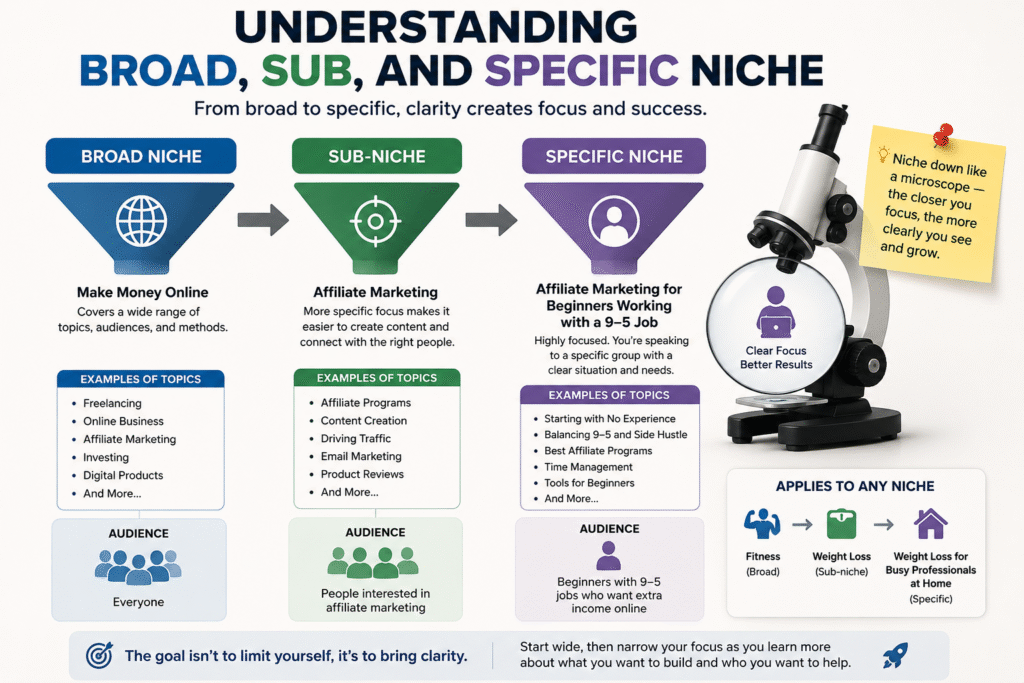
A niche usually starts broad, and then becomes more specific as you narrow it down. The mistake many beginners make is staying too general for too long, which makes it hard to know who they’re speaking to or what they’re really focusing on. But when you break it down and niche down, it becomes like using microscope, you understand more clearly what to focus on and who you’re serving.
For example, take something like “Make Money Online.” This is a broad niche. It covers a wide range of topics, audiences, and methods. From here, you can narrow ii down into a sub-niche, as “Affiliate Marketing.” Now the focus is more specific, and it becomes easier to understand what kind of content or message fits into that space.

From there, you can go even deeper into a specific niche, like “Affiliate Marketing for Beginners Working with a 9—5 job.” At this level, everything becomes more focused. You’re not speaking to everyone—you’re speaking to a clear specific group of people with a clear situation.
And this same structure applies to almost any area of business. For example, a broad niche like “Fitness” a Sub-niche “Weight Loss,” and then more specific “Weight Loss for Busy Professionals at Home.”
You might think this is limiting my abilities to reach wide range of people. No, the goal here isn’t to limit yourself, it’s to bring clarity. When you understand how to move from broad to specific, that’s where you stop feeling overwhelmed with too many options. Instead, you start to see a simple path: start with wide, and then narrow your focus as you understand more about what you want to build and who you want to help.
This is how what started I need to choose a niche, turns into a real business where you can build your income, time freedom, and fulfilment.
Mistakes That Will Keep You Stuck

At this stage, the biggest risk isn’t choosing the wrong niche, it’s falling into patterns that quietly stop you from making real progress. These mistakes don’t always look like mistakes in the beginning. In fact, they often seem like you’re doing the right thing. But over time, they’re exactly what keeps you gong in circles, frustrated, and starting over again.
Choosing Based on Trends Only
One of the most common mistakes is choosing a niche based only on what’s trending. You see something popular, people talking about it, and it pulls you in. It looks like an opportunity you shouldn’t miss, But the problem is, trends change quickly, and if there’s no real connection behind your choice, it becomes hard to stay committed. What looked exciting at the start slowly fades, and you find yourself losing interest just as quickly as you found it.
Switching Between Niches Too Early
Another mistake is switching niches too early. This usually happens when things don’t move as fast as you expected. You start something, give it a short time, and when results don’t come immediately, it’s easy that you assume it’s not working. So, you move on to something else, hoping it will be different.
I’ve been there myself. I switched multiple times, thinking each time that I just hadn’t found the right niche yet. But every time I changed direction, I was starting from zero again, new learning, new confusion, no real progress, it wasn’t until I stayed with one path long enough that things finally went to the right direction. It wasn’t perfect but because I gave it time to develop.
Trying to Do Too Many Niches at Same Time
And then there’s a mistake of trying to do many things at once. Instead of one direction, you try to explore multiple niches and ideas at the same time. It might seem productive, like you’re keeping your options open, but in reality, it spreads your attention too thin.
You end up doing a little here, a little there but nothing, moves forward in a meaningful way. Real progress comes from focus. When you commit your time and energy to one path, you begin to build momentum, and that is when things start to shift.
These mistakes aren’t random, they’re what keep people busy without getting anywhere. And if you’re honest, you’ve probably seen yourself in some of them. That’s an awareness problem. And once you recognize what’s been holding you back, you avoid repeating it. You move with clarity stay in one direction, and stay long enough. It doesn’t mean you can’t change the niche you chose or what’ve been doing, you can actually do that, but it means giving enough time to test and to understand before you move on too quickly.
Just Take Your First Step

Now if you’ve read this article, you have clear overview of how to choose a suitable niche, what can hold you back and how to escape it from. So, choose a niche that matches the three-core niche elements we’ve mentioned commit to it. Take a small step, create something simple, put it out there without waiting for it to be perfect. You will learn more from doing it, not from planning, and that’s how you step out from thinking to action from chasing trends to your real path.
If you feel like you’ve been going in circles thinking, planning, but never really moving forward this is for you. I’ve been in that exact same place, switching directions and overcomplicating everything until I found a clear path that actually worked. This free training will help you see things differently and move with more confidence. You can access it below